I was supposed to stay only a few days at Fin del Mundo, but I ended up staying much longer. A combination of reasons lay behind this choice — the irresistible green charm of the Amazon forest, the fascinating mysteries of ancestral medicine, and the wisdom of the indigenous women I came across. All of these intrigued me and motivated me to explore a little further, to dig a little deeper.
Doris, the owner of Posada Fin del Mundo, where I stayed, is a strong and tenacious indigenous woman — one who gets everything done quietly and impeccably. Her family is of Inga origin, an indigenous people spread across several regions of southern Colombia. Doris has managed the family business for a few years, since the time her parents passed away. Her father had been the proud founder of the enterprise that first brought tourists to the marvellous Fin del Mundo waterfall.
Around the posada — which is also Doris’s home — she is the reference point for everyone, family and guests alike. Not only that — while coordinating all the work required for the hospitality business, she prepares delicious indigenous meals and fresh juices with Amazonian fruits at the speed of light whenever visitors show up. She also makes beautiful craft jewellery using Amazon seeds, and guides house guests along mountain paths on her finca, teaching them about the great variety of Amazon plants while collecting their fruits and seeds.
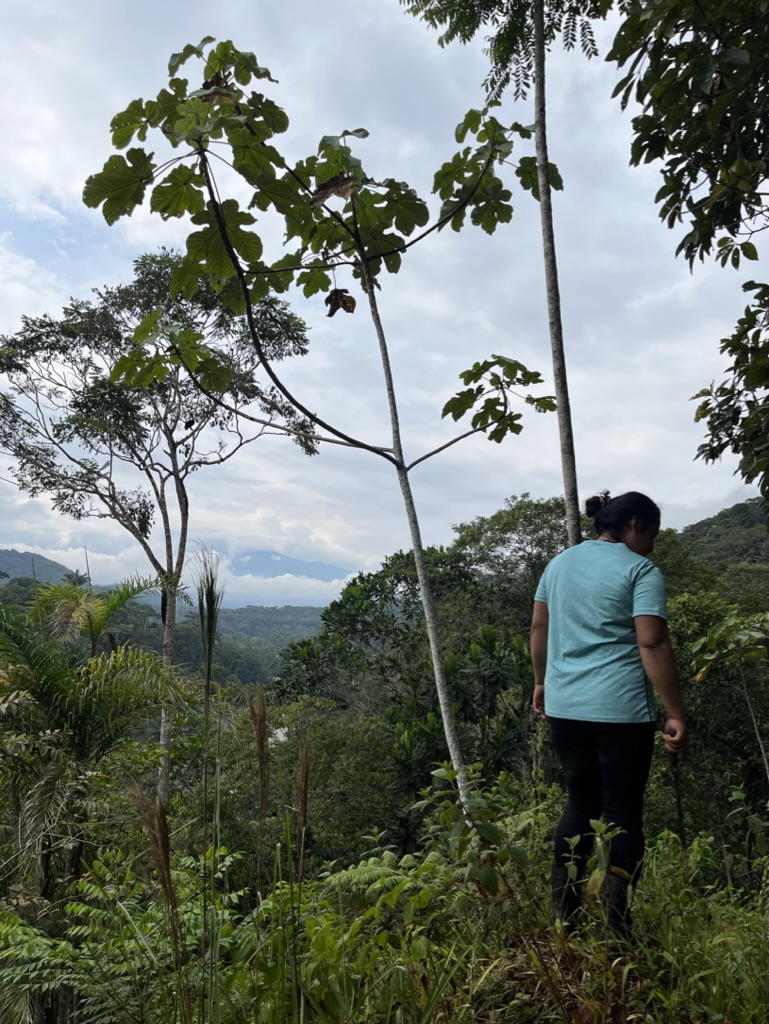
Throughout the days I spent at the posada, I hardly ever heard her complain, except for the occasional back pain. She is the kind of person who is content with what she manages to do, without putting pressure on herself or on others. She almost never asks for help, but humbly accepts it if others are willing to lend a hand. I have never seen her in a hurry, as she seems to know exactly when to dedicate time to her work and when to rest. With her steady tempo, she keeps moving forward with grace and harmony.
Doris may appear quite reserved at first, as she speaks very little to people she does not know. It took me a little adjustment at first, as I had become used to other types of personalities throughout my Latin American travels. When I arrived at the posada, I even wondered whether she was happy to have me there. But gradually, as we got to know each other a little better, the initial reserve disappeared.
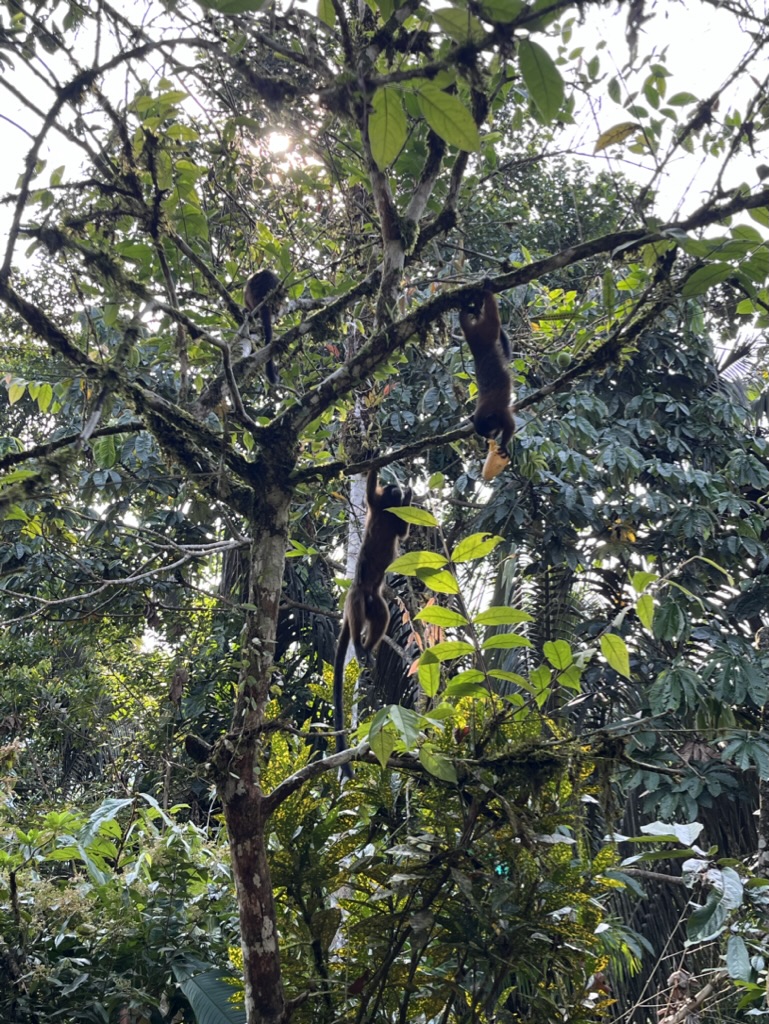
On my second day, unexpectedly, she shouted my name from the courtyard and asked me to join her downstairs. I ran towards her, a little perplexed. When I arrived, she directed my gaze towards a group of small hungry monkeys (called bozo de leche because of the white-coloured fur around their mouths), waiting for a treat from her. As she placed a bunch of bananas on a wooden platform, the monkeys did not wait a second to attack them. We laughed a lot, watching the family of monkeys eagerly devouring the bananas while hopping swiftly from tree to tree, some of them hanging upside down, defying gravity to keep the banana between their paws.
I remember the night when I discovered Doris’s talkative side and her additional talent — that of storytelling. I was sitting at the dining table, savouring my dinner, which comprised the unmissable rice, boiled chiros (small bananas), and scrambled eggs. As I asked her about her experiences with ancestral medicine, she told me about the time when she had been severely ill as a child and was treated by a taita (a male ancestral doctor) who rubbed nettle all over her body for three consecutive days. Since then, nettle has become her feared yet effective remedy for different illnesses.
Doris also told me about the capability of taitas to cure apparently severe and untreatable illnesses, such as that of a woman who, after losing her husband in an accident, had gone through a severe psychiatric delirium. While Western medicine had not been able to help her, she eventually overcame her illness thanks to the persevering help of a taita who administered ancestral plant remedies.
Any time I showed interest in an Amazonian or indigenous topic — from ancestral medicine to regional recipes using Amazon products — Doris would always have a story to tell or an experience to share. Once we went for a walk together, with her four dogs, around her finca to collect copoazú (an amazing Amazon fruit), which she later used to make a delicious smoothie. I even suspended my vegetarian habits one night to try her special maito de pescado — an Amazonian recipe in which a whole fish is grilled in a leaf of sirindango, an Amazon plant that gives it a special herby aroma. Doris also invited me to a demonstration she gave of Amazon recipes as part of an alliance of women dedicated to preserving and sharing knowledge of indigenous traditions, a project supported by the Ministry of Tourism of Colombia.

Doris helped me get in touch with an ancestral doctor, mamita Ana Peña, whom I visited to gain some understanding of Inga ancestral medicine. Mamitas are women who preserve the knowledge of ancestral plant medicine among the Inga people — they are the female counterparts of taitas. As such, they treat people who ask for their help in overcoming different illnesses — physical, mental or spiritual. They know about the beneficial properties of ancestral plants and put them to use through careful preparation and sacred rituals.
One common illness, which affects virtually anyone, is what ancestral doctors call mal aire. It can be regarded as a spiritual malaise that prevents people from having clear sight — a sight that does not stem from our physical eyes but from our third eye, the eye that looks more deeply into the essence of life and the understanding of the universe. To get rid of mal aire, ancestral doctors administer to their patients the most powerful and widely used ancestral treatment — la Medicina (with a capital M) — which is made primarily from Yagé (a psychedelic plant) along with other ancestral plants. While cleansing the person internally, Yagé enables one to see and understand more clearly, opening access to the subconscious through sensations and visions, and helping one resolve unresolved existential questions.
The mamita’s home was a very humble hut in the forest — open to it and deeply connected with it — sheltered only by a thin roof, a wooden fence and a few curtains. She had a little corner for her ancestral ceremonies — a table full of candles, leaves, bottles filled with remedies, and hanging pictures of Mary and Jesus. In front of this small altar hung a hammock where Ana Peña would spend most of her time, at times softly playing her harmonica. She moved slowly, acted slowly, spoke slowly — yet she did all of this with the strength and confidence of a person full of knowledge and experience. Her words were sharp, at times critical, but rooted in a deeper gentleness of spirit.

Mamita Ana Peña told me about her origins and her connection to ancestral medicine. Of Inga indigenous origin, she was born and raised in the Amazon region of Caquetá. Her grandfather was a taita and passed on to her the knowledge of ancestral medicine from her early years. The process of becoming an ancestral doctor is a demanding one. From an early age she assisted her grandfather in collecting plants, preparing remedies and performing ceremonies. She had to take Yagé regularly from a very young age in order to get to know the spirits of plants and of Nature and cultivate their powers so as to be able to treat other people. In this way, through a long and demanding education, taitas and mamitas become some of the most enlightened members of the indigenous community, keepers of the sacred powers of Nature and those who come closest to a deeper understanding of the universe.
Ana Peña has been devoted to her vocation since she was young. Yet the woman I spoke to seemed to me fragile, human and a little tired. Her words, bitter at times, revealed suffering and concern. When I asked, she opened up to me.
She feels that she is getting old, that her energy is fading, also because of several recent hardships — she had a heart attack a few months ago, she was affected by a severe Covid infection during the pandemic, and lately she has been suffering sleepless nights due to worries about the mental health of her son, who is going through an eating disorder and refuses any help. Because of her worsening physical health and her current worries, she no longer has the same energy as before to treat and help other people. She still does it, but at a much slower rhythm.
She has little trust in Western medicine — she had to be hospitalised for her heart condition, though she would have preferred not to — and she currently refuses to take any pills to prevent relapses. She also refused highly recommended vaccinations, such as those against Covid-19 and yellow fever (there was an outbreak in this region last year). She does not trust any form of treatment that does not originate directly from Nature.
I asked her whether she thought that Western and ancestral medicine could ever work side by side, complementing each other, but she could not give me a clear answer. “Ancestral medicine cannot treat everything, just as Western medicine cannot,” she admitted. “Some illnesses simply cannot be treated, and we should accept their natural course.”
Through my encounters with Doris and Ana Peña, as well as with other women and men of Inga origin in Mocoa, I was able to glimpse the enormity of indigenous tradition and knowledge, and to begin to grasp their understanding of the power of Nature and its extraordinary elements.
It is beautiful how indigenous people — and these women in particular — are able to connect deeply with Mother Earth — Madre Tierra — through their beliefs, work and daily habits. As such, they struggle to accept anything that interferes with this connection, such as Western medicine. Despite this, many indigenous people live long and healthy lives, as nature is the source of their nourishment, lifestyle and wellbeing. They understand their dependence on nature, which forms the basis of their profound respect and gratitude for the environment in which they live.
When we parted, Ana Peña gave me a strong hug and thanked God for our encounter and our sharing. “Gracias a Dios,” she exclaimed.
As a non-religious person, I was at first uncertain about how to respond. But then, putting aside all religious definitions, it occurred to me that the meaning of Dios might essentially be the very essence of our existence — and of the existence and togetherness of the world we live in: Nature, the Earth and all its life forms.
So I replied to her, “Gracias a Dios.” And I meant it.
Gracias a Madre Tierra.
Gracias a la vida.
 Gracias a la vida
Leave a comment