A few times, I found myself walking through the streets of Habana Vieja at dusk, heading towards a restaurant or a music venue. The mystical old centre of La Habana revealed itself to me in all its grandeur, with dim lighting, ancient palaces, and majestic trees. The colourful geometries of the palaces’ façades shaped enchanting plays of light. Everything looked charming and mystical—crystallised in a different, more ancient time. The uniqueness of the experience became even stronger as I realised how unique—how lonely—I was in those moments. Having read about La Habana and its history, I had expected a constantly buzzing, sleepless city. Instead, I was confronted, full-faced, with its ghostly and desolate side.
Last week, I went to a jazz concert in which Wendy—a brilliant and versatile musician, my violin teacher here in La Habana—performed as a vocalist. Like all Cubans who pursue a formal career in music, Wendy received a rigorous musical education starting in primary school. From a young age, she combined music classes with regular schooling, spending mornings and afternoons studying and practising. Music education in Cuba demands great commitment and perseverance from early on, but it eventually pays off: the quality and preparation of Cuban-trained musicians are outstanding. The educational curriculum is, however, quite old-fashioned, focusing almost exclusively on classical music rather than other styles and frameworks. As a result, when Wendy completed her studies up to a university degree, she had to cultivate her passion for jazz independently, teaching herself new scales, tempos, and instrumental techniques. Some guidance and mentoring might have made things easier, Wendy admitted, but this was something she never received during her many years of formal musical education. Nonetheless, she became an excellent jazz musician.
I was excited to see her perform. She played alongside David Faya, one of the best jazz bass players on the island, and his band, Camino de Santiago (a pianist, a percussionist, and Wendy as vocalist). I arrived at the César Jazz Café quite early, eager to see the venue and secure a good spot. Right at the door, the waitress greeted me by my first and last name, which—she explained—she had learned from my phone reservation. Immediately, I sensed that there might not have been many reservations. I entered the spacious and polished café, with its high ceilings, elegant wooden tables, leather-covered chairs, and thick velvet curtains. I was seated at a table directly in front of the stage, as no one else was there yet. The young waiters lingering at the bar embodied pure ennui: some attempted quiet chitchat, some hid behind a pillar scrolling on their phones, while others simply stared into nothingness. When I ordered a glass of wine and a cheese platter, I heard them buzzing with excitement at finally having a task to accomplish. It was 6:30 p.m., still an hour before showtime, so I sat quietly, sipped my wine, and read my book.
As the minutes passed, I began to look around with growing perplexity, wondering whether I had misunderstood the concert time. No audience appeared—apart from me. At 7:35 p.m., the musicians stepped onto the stage, and David Faya, smiling genuinely, announced that it would be a private concert, just for me. They played with absolute dedication nonetheless. Their music was outstanding, as was their energy: they were completely carried away by the powerful, spontaneous dialogue between their instruments. I was transported too, and throughout the entire one-hour concert, I felt unable to miss a single note. I stopped drinking and eating and allowed myself to be fully absorbed. After two instrumental pieces, punctuated by breathtaking solos, Wendy joined them on stage, blending her mesmerising vocalisations with the instrumental soundscape. Their final piece, Alfonsina y el mar, went straight to my heart, reminding me of how music can uncover emotions in their purest form. It was a unique concert in every sense—one I will never forget.

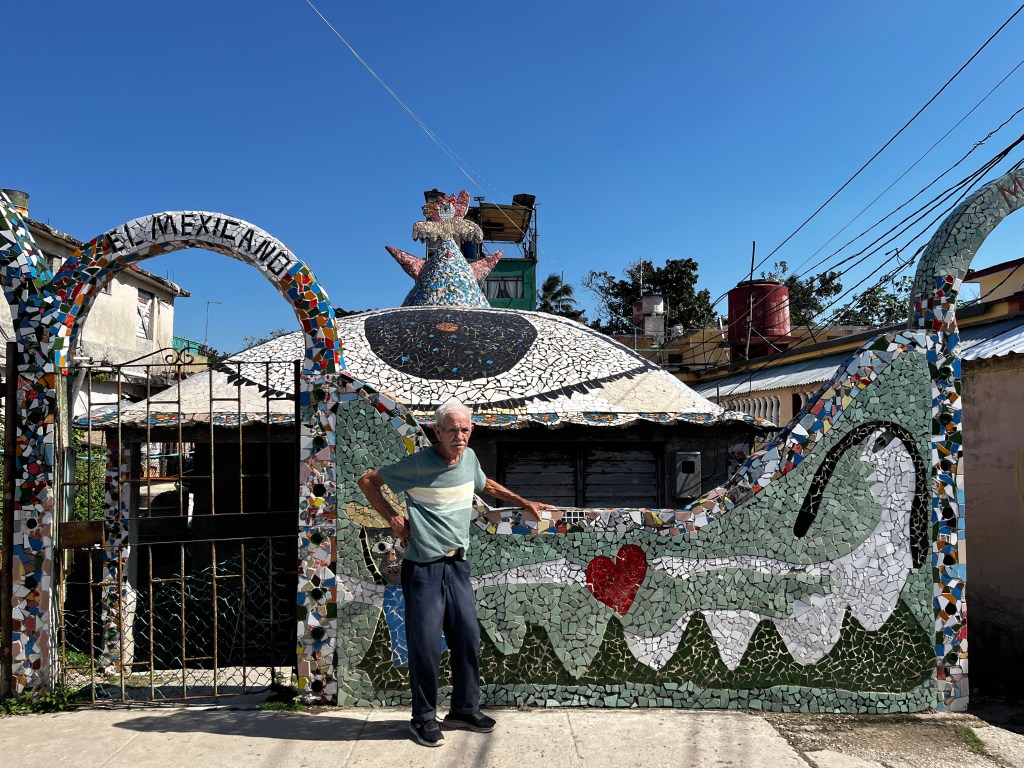
There were a few other similarly unique experiences. I visited Fusterlandia, a neighbourhood of La Habana completely transformed by the Cuban artist José Antonio Rodríguez Fuster into a vast, mesmerising artwork. In Fusterlandia, every building, wall, bench, and patio—literally everything—is decorated with colourful ceramic mosaics, carefully designed to depict stories, living and spiritual beings, natural elements, and written phrases. Inspired by Gaudí and Picasso, Fuster conceived this project as a community-engaged artistic and social initiative. It began in 1994, during a year of severe economic crisis in Cuba, as his attempt to spread joy and positivity among the Cuban population while also creating work opportunities. The final result, involving more than 150 houses, is unique and captivating.
As I walked past his house, an elderly neighbour, Jorge González, told me that he had been one of the first people approached by Fuster when the project began. His home had once been a humble wooden structure, but Fuster helped transform it into a more solid stone house, embellishing its exterior with fantasy, symbolism, and colour. The mosaic designed for this house was called El Mexicano, inspired by Jorge’s passion for Mexican films. Although his dream of visiting Mexico remained unfulfilled during his lifetime, the Mexican spirit—brought to life by Fuster—now lingers around his home.
Like my solitary experience in Habana Vieja, my visit to Fusterlandia evoked a double sense of uniqueness: discovering an extraordinary creation that seems, at least in part, forgotten by the rest of the world. Very few visitors were present, and the Fuster-designed restaurant and café were completely empty—another clear sign of the difficult moment tourism in Cuba is facing.
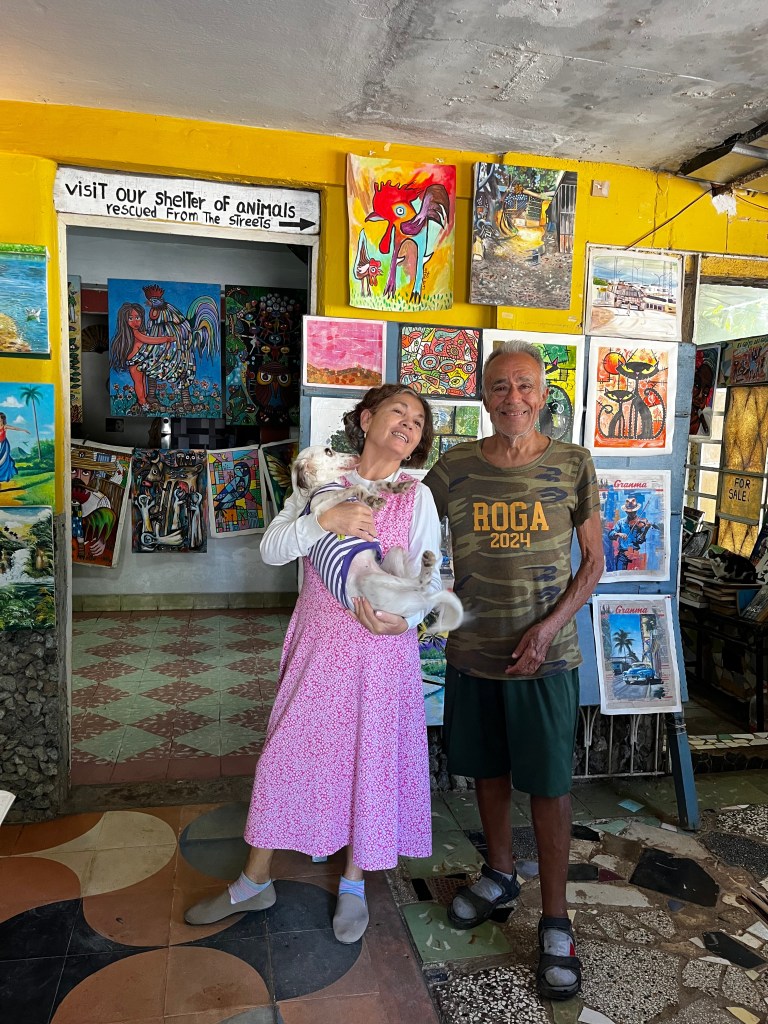
I continue to be impressed, however, by the stories of resilience and solidarity among Cuban people despite the harsh circumstances. As I was leaving Fusterlandia, I came across an art gallery and animal shelter created by Nelson and Marielena. This wholehearted couple transformed their home into a place of welcome, comfort, and care. By rescuing dogs and cats from the streets and helping them find new families, they currently host more than 50 cats and 25 dogs. Their space also exhibits the artwork of their 29-year-old son, Nelson Jr., a skilled painter whose work faithfully reproduces famous masterpieces, making them accessible to both locals and visitors. In this way, Nelson and Marielena truly embrace Fuster’s vision of art and community, reshaping it through their own generous and unique project.
Lately, I have developed the habit of taking a scooter taxi to get home at night. It has become a cherished way of experiencing the city in an unfiltered manner: catching glimpses of the nocturnal wanderings of the few people still around, observing the silence of entire neighbourhoods, feeling the ocean against my face—like Alfonsina’s ancient voice of breeze and salt (“una voz antigua de viento y de sal“)—feeling alive and part of this unique cosmos that is La Habana. While sitting on the scooter, I was surprised to notice how visible the starry sky is—something I would not have expected in such a large city.
This has taught me something. In the current circumstances, La Habana feels a little more obscure, in many ways, than I had expected. Yet even its obscurity has a brighter side, reminding me every night of all the unique stars I have been able to discover—simply by looking a little more closely, a little further. Even in the deepest darkness, there is light, dream, and hope for a brighter tomorrow.
 Gracias a la vida
Leave a comment