Since I first arrived in La Habana, from my casita I would hear a man shouting from the streets — sometimes even several times a day — repeating the sounds [aɪ paɪ, aɪ paɪ]. I am writing them in the phonetic alphabet to make one thing clear: I had no idea what the man was trying to say — to me, it was just meaningless sounds. He would go on and on, and I would wonder — each time — which language this man was speaking. It took me approximately ten days to figure that one out, as one day he added a few extra words to the riddle: ‘Hay pie, hay pie, el pie de coco y guayaba’. That’s when I realised that the guy was going around on his bike — once I was quick enough to spot him from the window — selling coconut and guava pie.
I am living in a rather rich neighbourhood of La Habana, Miramar, which hosts the foreign embassies and, as a result, a large group of international people as well as local people working in international affairs. One afternoon, after having had my good share of midday Caribbean sun, I decided I would go and try the neighbourhood’s ice cream shop, Heladería El Gelato. While sitting and enjoying my cone with dark chocolate and guanábana (a tropical fruit) flavours, I noticed one thing — no ‘common’ Cuban people were there. There were only foreigners and a handful of elegantly dressed Cuban people, with designer clothing and expensive watches, which is something you virtually never see in the streets.
Once I returned to my casita, I shared what I had noticed with Lázara, who — once again — helped me get wiser on the matter. That ice cream shop is unaffordable for most Cubans; the people — el pueblo — cannot afford spending one fifth of their monthly salary on one ice cream. A small ice cream had cost me 1100 pesos (2.5 euros, more or less), and it hadn’t even crossed my mind how expensive it could be for the average Cuban person. These thoughts triggered something in me. In my mind, that ice cream didn’t taste so good any more — rather, it tasted bitter, like the unfairness of the double standards that exist in Cuba, separating the common people from the rich people, such as foreigners or the few locals having foreign incomes. Since then, I have been trying to choose my eating spots more carefully — avoiding eating with the rich ones, choosing to eat with el pueblo, thereby investing in the work of people that ask a little less but need a lot more. This approach has brought me a few nice surprises — and absolutely no regrets.
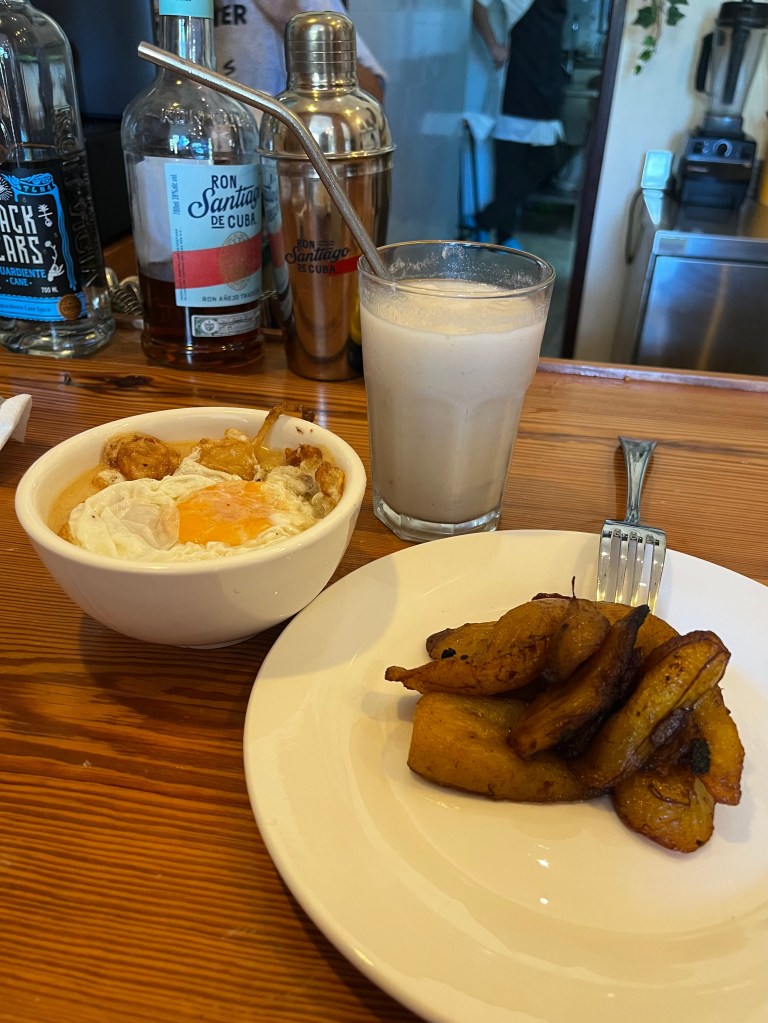
On my first day in Habana Vieja, I was very lucky to end up — with a little Google Maps guidance — in the place that has now become my favourite paladar in town. Back then, I didn’t even know what a paladar was. It is a small, family-owned restaurant, making simple but tasty food, usually at affordable prices (the equivalent of the Italian trattoria). At Paladar La Lore I tried, for the first time, all my favourite Cuban dishes thus far — a corn pudding served in a small casserole and topped with an egg (tamal en cazuela), plantains in different forms, either fried (plátanos fritos), mashed (fufú de plátano) or turned into small pancakes (tostones). I also tried a typical Cuban drink, the champola, which is a dense smoothie made of guanábana, a yummy tropical fruit with a white pulp. Paladar La Lore is a central and popular place; because of this, it has lost some of the homey atmosphere most paladares have. But it is, I believe, the best paladar to be found in Habana Vieja — an honest and welcoming place where food is delicious, portions are generous and prices are fair.
One morning, on my way to music school, as I walked past the embassy of Namibia, I noticed a sign on the street. It said ‘empanadas de coco y guayaba’ (yes, coconut and guava are very common fillings for pastries and sweets here in Cuba). Having a half-empty stomach and a few hours of music school ahead of me, I thought I’d give it a try. Asbel, a friendly old man, came out from inside his home and handed me a homemade, beautifully chubby empanada. I took a bite, savouring the sweet softness of the guava — and it was love at first bite.
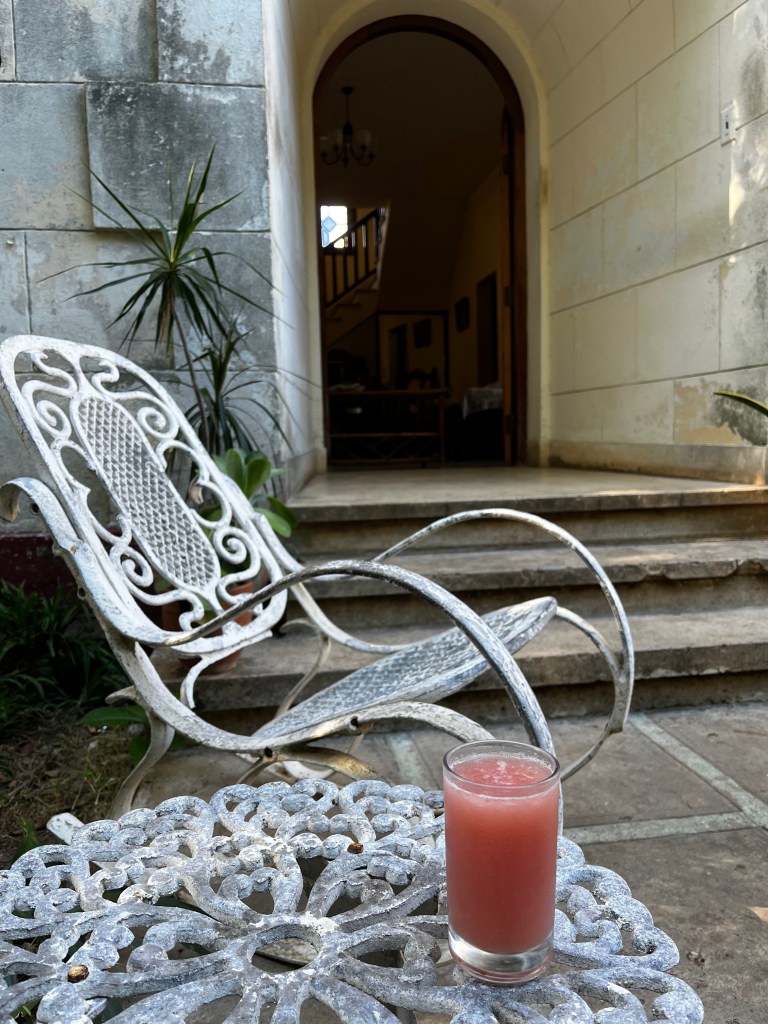
Under the same circumstances, a few days later — on my way to music school — I stopped again at Asbel’s for my beloved empanada. My heart was broken when I heard from him that, unfortunately, he had just run out of them. I walked a little further, and by chance I noticed an open gate leading to a beautiful patio. Celia, a lovely lady with a colourful apron and a grandmotherly look, stood at the door of the house, which was wide open. She asked, with a caring smile, ‘Merienda? Cafecito?’ (‘A snack? A coffee?’). I jumped into her patio before she could even mention all the delicacies she had prepared. Not many options were vegetarian, but she offered freshly made guava juice, which was exactly what I needed to make up for my, until then, unsatisfied guava cravings. I spent a few blissful minutes sipping guava juice in her beautiful patio. Next time — Celia told me, as I walked away — she would make a special vegetarian sandwich just for me.
You might have imagined — it’s not always easy to be a vegetarian in Cuba. In most paladares and cafés, waiters panic as I tell them I’m looking for an almuerzo — the main meal of the day — without meat. At the café El Portal, though, no one panicked upon my request. The waitress Alicia and the chef Dairón were happy to improvise on the spot for the unexpected vegetarian visitor. The result was a dish of sautéed vegetables with some toasted bread on the side, simple but very enjoyable. Alicia had the brightest smile when she saw me quickly eating up the full dish (I was really hungry that day), even brighter when I told her I would go back for more vegetarian experiments in the following days. Alicia and Dairón are such joyful and caring people, who make me feel at home any time I go back to El Portal.
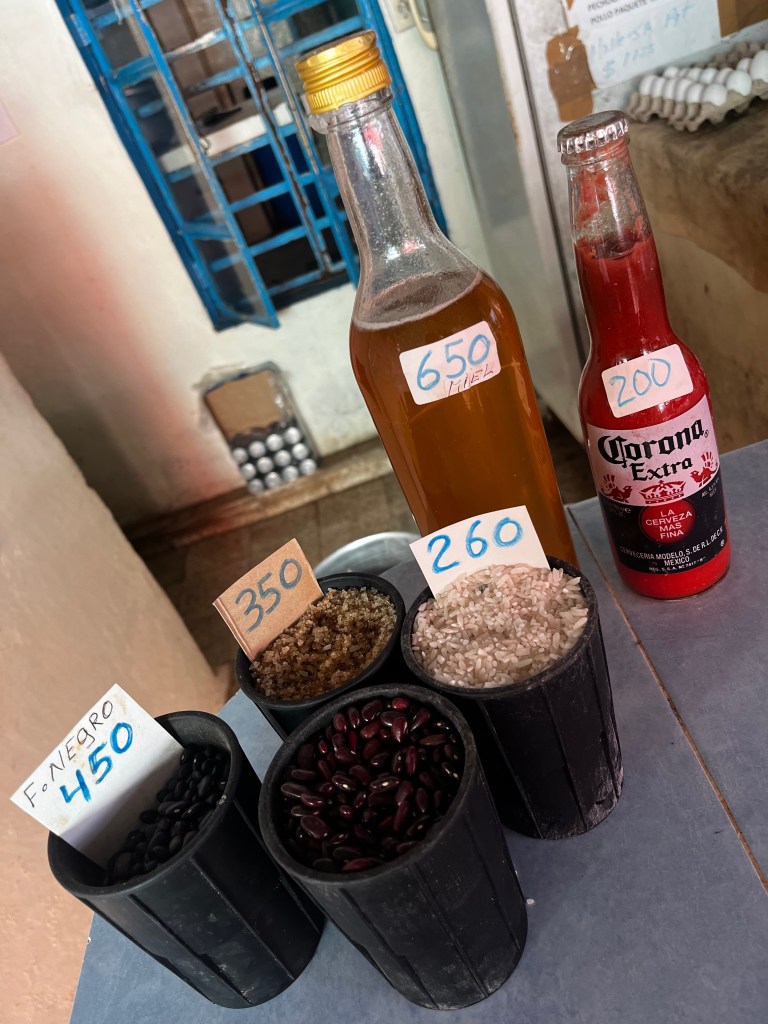
Located in a peripheral neighbourhood of La Habana, Paladar El Callejón was extremely hard to find. I wouldn’t have arrived there if it hadn’t been for a man who guided me through the smallest street of the neighbourhood, where a tiny gate opened onto a terrace that served not only as a paladar, but also as a food market and a second-hand market for all sorts of things. Upon my arrival, I thought that my picky vegetarian requests wouldn’t stand a chance, but the incredibly versatile woman working there (doing practically everything — from cooking to serving, cleaning and selling) didn’t hesitate for a second. She told me, assertively: “I have eggs and white rice. Do you like tomatoes? I will make you a tomato salad too.” I barely had the chance to respond. In a matter of a few minutes, she had prepared everything and brought the dishes to my table. What a peculiar place to be for an almuerzo, but — why not? The food she made was good. Plus, while eating I could look around, admiring piles of rare market goods, and speak to Raúl and Mario, sitting right next to me, who were amazed at how I had come across such a small and unknown paladar.

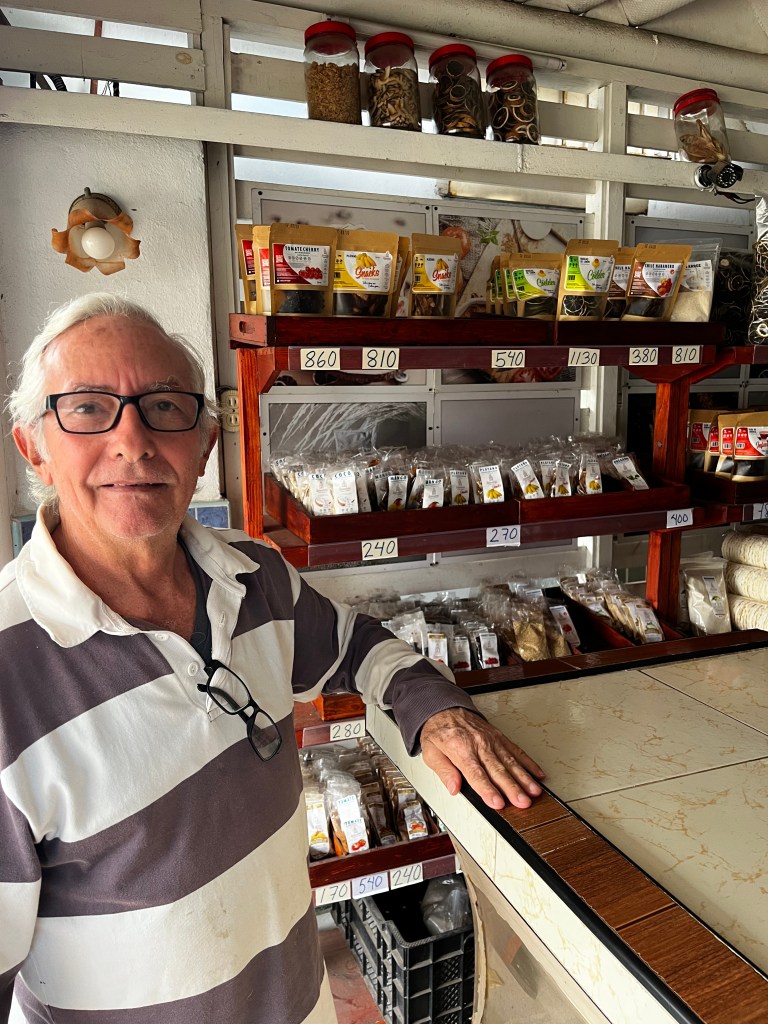
Homemade delicacies are not only offered on the tables of paladares, but there are plenty of local people selling them either at their place or out in the streets, who become, in this way, trusted suppliers for the entire neighbourhood. Recently, I came across (and adored) Ricardo’s dried fruit store. He and his family opened their home store to sell all sorts of delicious fruits and herbs, which can be used as snacks or ingredients for cooking, such as dried coconut, plantains, hibiscus, pepper, dried tomatoes, and much more. Other memorable surprises were finding homemade tomato sauce being sold in Corona beer bottles, or getting coffee poured into a repurposed yoghurt cup.
Cubans are generous and resourceful people, who do what they can to get by. Those who can prepare shareable products in their homes do it, and do it for the rest of the neighbourhood as well. What they ask for may seem small and insignificant, but it is of fundamental value — a value that is more social than economic, I believe. While making things for others, they get the chance to see each other, to strengthen their network, to maintain a strong sense of community. Each one of them knows whom to address for a specific need, while looking for a certain product or craving a merienda or a cafecito. There is solidarity, there is community, there is el pueblo — even in a large capital like La Habana.
As for me, I still haven’t been able to stop the guy shouting ‘Hay pie, hay pie’ and get a piece. But the thought of him, cycling tirelessly through the streets, making everyone pleased with his tasty pies, is enough to make me happy. Also, I haven’t given up on ice cream completely — the wise Lázara has recommended another place where ice cream is good and much more accessible, where I hope I will finally sit and enjoy an ice cream that doesn’t taste unfair: the ice cream for el pueblo.
 Gracias a la vida
Leave a comment