In Cuba, music is a fundamental element of people’s life. Live music, in Cuban traditional styles — son cubano, rumba, salsa — enlivens many public spaces, from Casas de la Música, to restaurants and cafés, and the streets, of course. You will see plenty of musicians with guitars, percussions, or traditional instruments such as the tres cubano (a guitar with three courses of double strings). However, when it comes to buying a guitar, or renting one for a limited period of time, the matter gets more complicated. It took me three days of going back and forth to and from Habana Vieja — the old centre of La Habana —, talking to multiple people, making various attempts to strike a good deal, to finally get a guitar for myself.
I had realised it would be a difficult task to get hold of a guitar when I first asked my Cuban music school for help. The school manager, Claudia, knew no easy way to rent a guitar, nor to buy one for a good price. She told me I could come and practice with the school’s guitars a few hours a week, but even renting one from the school was not allowed. Guitars are rare items to find in Cuba, the imported ones are sold at a costly price, and there are no such things as music stores.
I thought I could try and solve this problem in the streets, where many musicians linger. It all began last Saturday, when I visited for the first time Habana Vieja. I had just arrived at Plaza de la Catedral, when a 60-year-old Cuban guy came up to me, speaking perfect Italian. His name was Ariel, his nickname Morgan Freeman (he really did look like him). He had had a girlfriend from Reggio Emilia a few years back — that’s why he could speak Italian so well — and he used to work as a mechanic.
Ariel was not well, though. Beside losing one leg a few years ago in a motorcycle accident — because of which he’d been walking around on crutches — he had an infected wound in his good leg. He had gone to the hospital — as hospitals in Cuba are public and open to all — where doctors had given him a diagnosis but not a treatment. He had received a prescription, but he had no means to get his meds. Medications are hardly accessible in Cuba — Ariel told me. Some basic treatments can be found in international pharmacies, yet they are expensive and can only be paid using foreign currencies, such as dollars and euros, which most of the population does not have nor can easily access. That’s a terrible injustice that Cubans have to endure, as the country seems to function on two different tracks: a ‘conventional track’ where people hardly make enough pesos to pay for their basic necessities, and have to continuously reinvent themselves to get by (like reselling, or taking up informal jobs), and a ‘privileged track’ where those who have access to foreign money can buy more, and sometimes even cheaper, goods. One thing is clear — if you do have foreign money, in Cuba you are better off. I gave Ariel some euros to buy his meds — I hope he managed.
But back to the guitar story — I thought I could ask Ariel whether he knew where to find a guitar, as he seemed to know his way around Habana Vieja. He immediately stood up and led the way to Callejón del Chorro, a small street filled with restaurant tables and some local people gathered at the edges. A few musicians were sitting at the end of the street, waiting to start a gig. Ariel introduced me to Ranzen, a young Afro-cuban guitarist with dark sunglasses and a bright smile, who made a few calls for me, and eventually found a guy who could — perhaps — get me a guitar. That’s when I became known to many as ‘la muchacha italiana que busca una guitarra’, the Italian girl looking for a guitar. While waiting, Ranzen played and sang a Cuban-sounding version of ‘Volare’ for me, and it was good fun to listen.
A little later, Luis arrived bringing along his guitar. Luis is a guitarist who has been having a hard time playing, these days, as he recently got a Chikungunya infection. In Cuba there has been a large epidemic of Chikungunya, a virus that affects the joints and can lead to joint pain lasting for even weeks or months. Luis told me that his fingers still hurt a lot, while playing, and that he can’t work as much as he would like to. He thought he could lend me his guitar for a month, so that he could rest and get some extra money in the meanwhile. How frustrating must it be — I thought — not to be able to do the one thing you do all the time, and you need to do as a living. We agreed on a ‘provisional’ deal, as he needed to play the guitar one more time before handing it to me. We would meet the next day at 11 am, same place.
The next day, I went back to Callejón del Chorro. I asked around for Luis, but he hadn’t showed up yet. I called him up — he wasn’t feeling too well, his joints hurt more in the morning, so he suggested that we meet up later. While roaming around Habana Vieja, I met another group of musicians: Ernesto, Elindo and Papiro. I shared with them my longing for a guitar, and they sympathised. Ernesto said he might know somebody
giving away a guitar, and asked me to pass by the café El Pirata (where they would play live in the afternoon) to talk about it later.
I walked away, but music had decided to stay in my way. A few streets further, at Plaza de Armas, I found another trio of musicians playing on the streets, Los Mambises. The trio included one guitarist, one tres player and one singer, probably all of them older than 70 years old, but conveying — through their music and rhythm — incredible youth and energy. The singer was a tiny, short guy, with only two teeth left in his mouth but a vibrant and deep voice, which resonated through the entire plaza. They sang for me the beautiful song ‘Dos gardenias’, intercalating the words ‘I love you’ a bunch of times among the song lyrics. I was in awe.
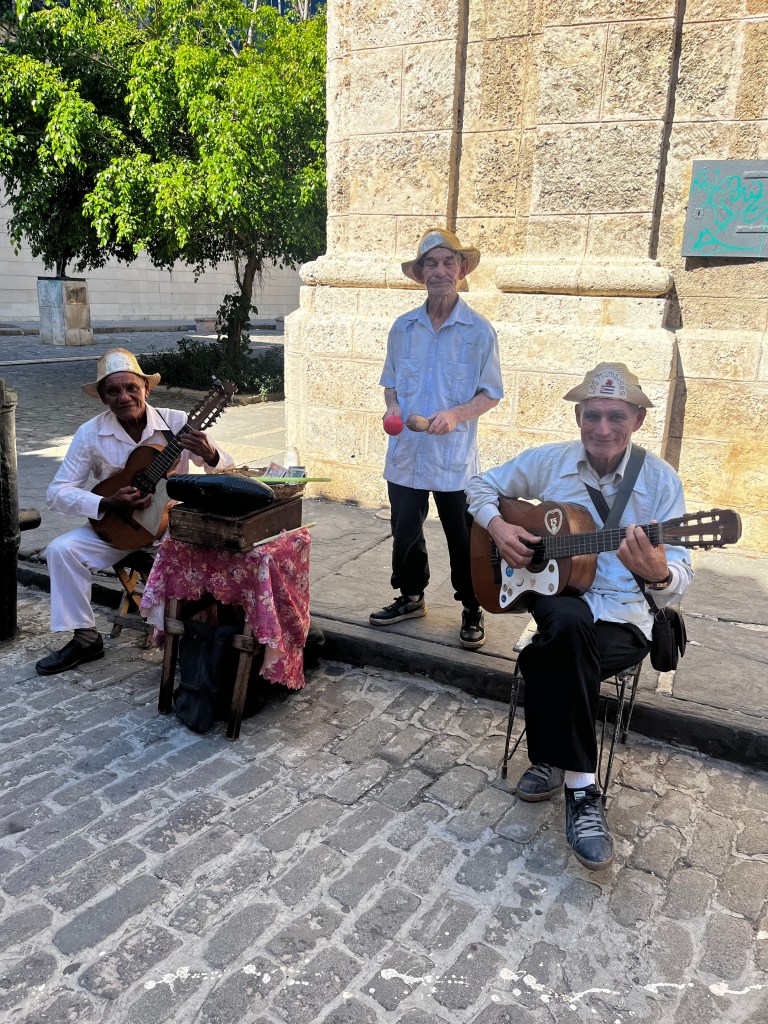
In the afternoon, still no news from Luis. I went to the café El Pirata to talk to Ernesto. An acquaintance of his would be willing to lend a guitar, he told me, but the price he asked for was way too expensive. At that point, Elindo took the initiative, and came out of the back of the café with a guitar that was falling apart, missing two strings and having a large crack on the back. He said he would find the owner of the guitar and ask whether it could become mine — after some needed fixing, clearly. I went along, curious about where this would lead, once again. Anjel, the owner of the guitar, was willing to sell it, but the price was way too high, considering its condition, so we couldn’t find a good compromise.
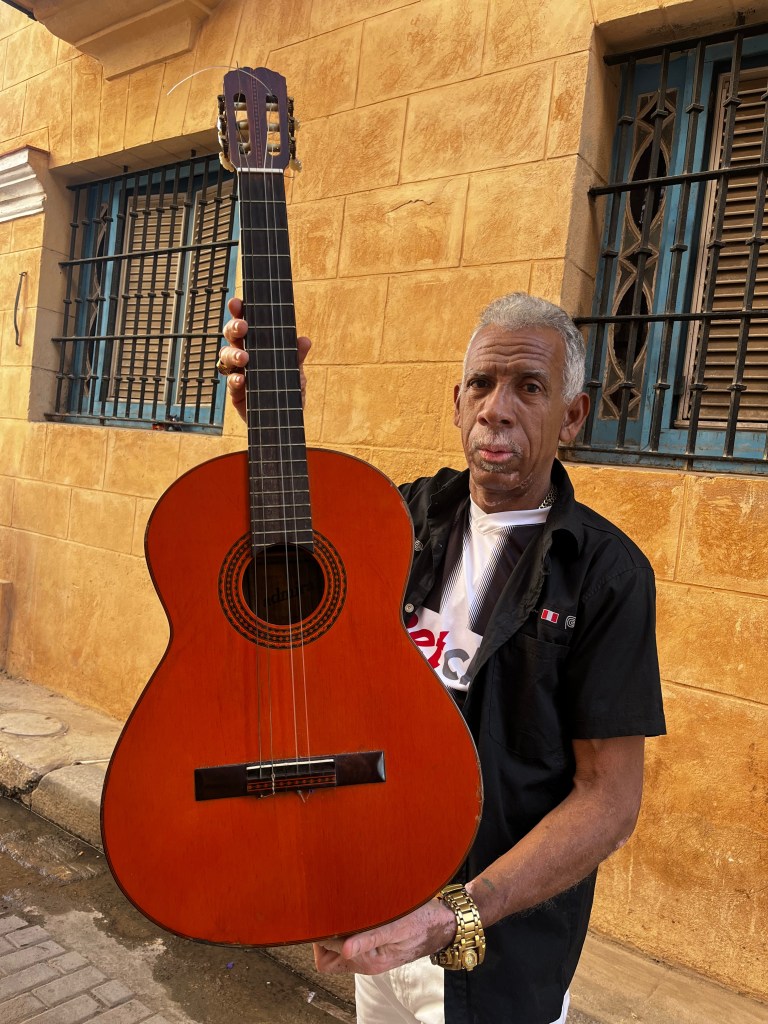
I had lost all hopes, and was ready to give up, when Luis called me and asked me to meet at the cathedral. He said he wasn’t ready to part with his guitar (understandably, I thought), but he had found yet another guitar for me. He arrived, a couple of minutes later, with the Hermanos Burton, two brothers who worked as luthiers and were in touch with the owner of the guitar. I actually quite liked the guitar, and was ready to buy it, yet the owner did not agree to our offers. Luis and the luthiers spent another 20 minutes trying to convince him on the phone, and I tried too for a couple of minutes, but the deal was not to be made. Exhausted after all the bargaining and calling, with no guitar in my hands, I decided to go back to casita. Papiro tried to make me feel better — ‘you haven’t got your guitar today, then you will get it tomorrow’.
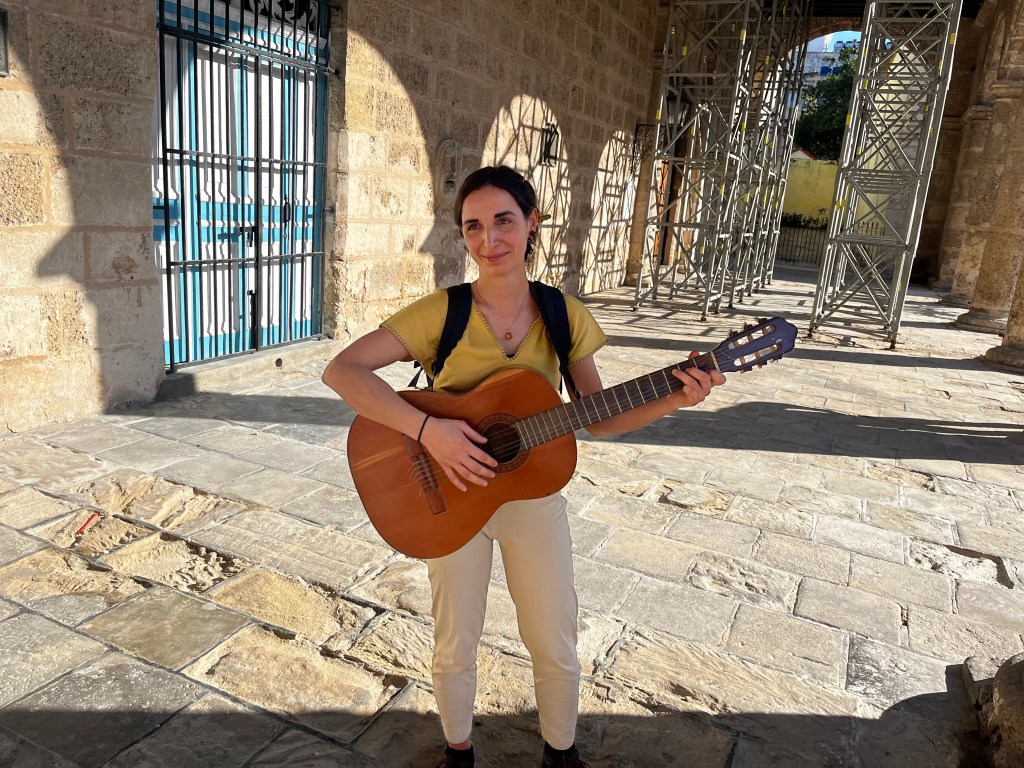
The next day I had my first lesson with Adrián, guitar teacher, at the Havana Music School. I tried to wrap my head around the rhythm of son cubano on the guitar, practicing the popular song ‘Chan Chan‘. After the lesson, I asked Adrián for help finding a guitar. A lot of the offers for second-hand guitars can be found on Telegram (a widely used platform for many things in Cuba), he said, and gave me a few general suggestions; most important one, watch out for people that will ask for excessive prices to you as a foreigner. He suggested that I fake a Cuban accent and a Cuban attitude. I told him that I wasn’t ready to handle that, at least not yet.
I was about to start digging in the guitar trading once again, when I got a call from Ernesto. He had found a decent, entry-level guitar that was being sold at an honest price — good enough for me to practice while in Cuba. In a matter of minutes, I called the owner on the phone, we stroke a deal, Adrián approved, and Ernesto showed up with the guitar. So, after an endless chain of failed attempts, the whole situation was sorted out before I could even realise it. As Papiro had said, I just needed to believe that I would get my guitar the next day — and I did get it.
This was the very long story of how I found my guitar in Cuba. But, above all, that’s the story of how I found muchos amigos músicos (many musician friends), who are all willing to share their music passion and knowledge with ‘la muchacha italiana que busca una guitarra’. It can only get better from here.

 Gracias a la vida
Leave a comment